A dryer should take work off your hands, including the bending, reaching, and water carrying that can make laundry exhausting. Our first choice is the Miele TSD 643 WP when larger loads and a planned drainage setup matter most. For a laundry area near a bedroom, we favor the Whirlpool CWD86MWBRFR. But reduced mobility changes the buying order: start with the movements your room and appliance will demand, then consider capacity and electricity use. Your living room has hosted the drying rack long enough.
Contents
- Which dryer should you choose when bending and reaching are difficult?
- A dryer beside the washer can make laundry transfers less demanding
- Choose the Miele dryer for larger loads and a planned water drain
- The quieter Whirlpool dryer suits laundry rooms near bedrooms
- The larger Whirlpool dryer suits cotton loads if tank emptying is manageable
- Frequently asked questions
- Which tumble dryer should a wheelchair user choose?
- Should you raise the dryer or stack it above the washer?
- How can you avoid emptying the water tank manually?
- Does a heat pump dryer need an outdoor exhaust duct?
- What capacity reduces handling, and which controls suit limited hand strength?
Which dryer should you choose when bending and reaching are difficult?
Choose around your hardest recurring movement. That might be reaching wet socks at the back of a drum, lifting a water tank, or pulling a filter free with limited hand strength. A generous drum does little for independence if unloading it leaves you waiting for help. We would put the complete laundry routine ahead of a long program menu.
Picture the route from your washer to your closet. Where does the basket sit while you transfer damp towels? Can you approach the dryer from your usual seated or standing position? Does an open appliance door interrupt that approach? These are practical buying criteria, especially in a narrow laundry closet where changing position takes effort.
For households handling substantial cotton loads, our starting recommendation is the Miele TSD 643 WP. Its capacity is 9 kg, with a drum volume of 120 L. Those specifications put it among the stronger choices in our selection for larger loads. The included drain hose also makes water handling an important part of its installation plan.
For a room beside a bedroom, choose the Whirlpool CWD86MWBRFR instead. Its published sound level of 60 dB places it among the quieter options in our selection. That is a concrete reason to favor it when someone may be resting nearby. It still requires manual tank emptying, so include that task in your decision.
Neither recommendation turns a specification into an accessibility guarantee. Before ordering, have the seller demonstrate the door, controls, filter removal, and tank handling from the position you actually use. Ask for a demonstration that follows the whole routine, including retrieving small garments. A handle that opens comfortably while standing may be awkward from a wheelchair.
Our firm advice is to choose the model whose recurring tasks fit your movements. If another person will handle maintenance or water emptying, agree on that arrangement before delivery. Independence can mean managing everything yourself, or having a reliable plan for the specific jobs that require help.
A dryer beside the washer can make laundry transfers less demanding
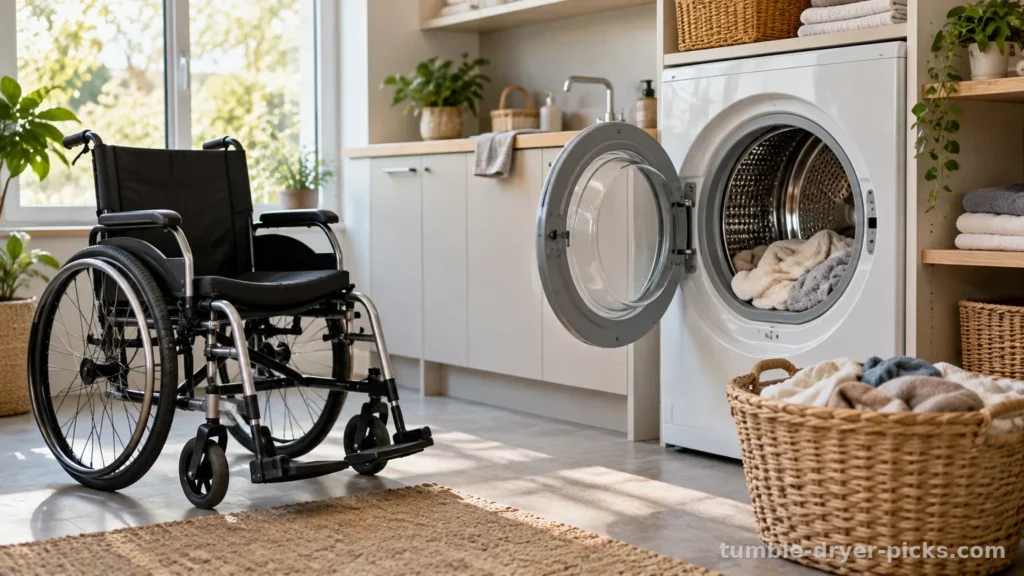
A laundry room can look spacious until the doors are open and a basket enters the picture. For reduced mobility, the useful space is the space available while you work. Plan your approach, your turning room, and somewhere to rest the basket before choosing the appliance position. Damp bath towels are an unhelpful addition to an already awkward reach.
We favor a side-by-side arrangement when it gives you a manageable transfer height. It can reduce the need to carry laundry across the room. The result still depends on your washer, your reach, and the door positions. Arrange the route so that you can move garments in comfortable portions rather than lifting a loaded basket simply because the appliances are close together.
The Whirlpool FFTDNM229X2BSFR and Whirlpool CWD86MWBRFR are freestanding, front-loading models. That makes them relevant candidates for a side-by-side layout. We would choose the Whirlpool FFTDNM229X2BSFR here when substantial cotton loads are the main concern. Its suitability still rests on the access you have once its porthole door is open.
The Miele TSD 643 WP is categorized as built-in. Its cabinet measures 59.6 cm wide, 64.3 cm deep, and 85 cm high. Use those dimensions to plan its place in the room, then allow the clearances required by the manufacturer. Cabinet size alone does not describe the space needed for an open door, connections, or your approach.
Raising a dryer deserves the same careful planning. A higher opening may reduce bending but move the controls, filter, or water tank farther from a seated user. Choose an elevation only through a manufacturer-approved installation arrangement, with the routine tasks considered together. Solving the loading problem while creating a water-tank problem is a poor exchange.
Stacking above a washer is particularly easy to overrate when floor space is tight. Make compatibility and the specified stacking equipment part of the installation decision before committing to that layout. Arrange delivery through to the final position, connection work, and packaging removal. For someone with limited mobility, a dryer left at the front door is unfinished business.
Choose the Miele dryer for larger loads and a planned water drain
The Miele TSD 643 WP is our first recommendation for larger cotton loads when water handling can be addressed during installation. Its 9 kg capacity and 120 L drum give substantial laundry room to move. For a household working through bath towels and bedding, that is a more useful starting point than a collection of specialized programs.
The capacity figure applies to cotton at full load. Synthetic fabrics have a much lower load allowance. Organize laundry around the permitted program load and garment care instructions, rather than treating the headline capacity as a target for every basket. Workout clothes needed the next morning may call for a very different load from the household towels.
A larger drum can accommodate more laundry, but it does not remove the effort of putting garments in and taking them out. We like the Miele for households that benefit from larger batches and can manage unloading in comfortable portions. Avoid choosing it purely to make every load as large as possible if prolonged reaching is what causes you difficulty.
Water handling is the other reason it leads our recommendation. The Miele has a tank to empty and includes a drain hose. Plan a compatible drain connection with the installer so that routine water disposal fits your abilities. The hose belongs in the installation conversation before the appliance arrives, particularly if carrying a filled tank would be difficult.
Its current energy classification is C. The older classification is A+++, but those scales cannot be compared directly. Use the current classification when comparing these models: the Whirlpool CWD86MWBRFR carries A, while the Whirlpool FFTDNM229X2BSFR carries E. For someone concerned about electricity use, those distinctions should remain visible beside the capacity figures.
The Miele also offers delay start and a quick program. Delay start helps schedule the laundry around your day; it does not shorten the physical routine. Its published noise level is 64 dB, around the selection average. Choose the quieter Whirlpool instead for a bedroom-adjacent location. The Miele earns its place through larger-load suitability and its included drainage equipment, rather than through a quiet-room advantage.
The quieter Whirlpool dryer suits laundry rooms near bedrooms
If the laundry closet shares a wall with a bedroom, our choice is the Whirlpool CWD86MWBRFR. Its published noise level of 60 dB makes it better suited to that location than the Miele TSD 643 WP or Whirlpool FFTDNM229X2BSFR, both rated at 64 dB. A quieter appliance deserves priority when rest and laundry have to share a small home.
That recommendation comes from the published specifications. Room acoustics and placement still shape what reaches the next room. We would use the sound rating to choose among these dryers, then place the appliance according to its installation instructions. A low sound figure does not turn an apartment laundry closet into a soundproof booth.
The Whirlpool CWD86MWBRFR also has the strongest current energy classification here, A. All these models use heat pump drying, a technology that uses less energy than vented drying but works more slowly. For a reader trying to reclaim the living room without pushing electricity use in the wrong direction, this Whirlpool makes the clearest combination of quieter operation and favorable current energy classification.
Its 8 kg cotton capacity suits an everyday washer load. Meanwhile, the 127 L drum provides generous internal space for laundry to tumble. Those figures describe different things: drum volume is the available space, while the load allowance governs how much suitable laundry belongs inside. A spacious drum is not permission to exceed the program limit.
Avoid this model if your main goal is handling the largest cotton batches in this shortlist. The Miele and Whirlpool FFTDNM229X2BSFR are better suited to that job. Also account for the condensate tank, which requires manual emptying. A quieter machine can still leave you with an inconvenient carry to the sink.
Its delay-end feature helps place completion around your routine, and a quick program is included. We like that scheduling flexibility when laundry needs to be ready while help is available. Before purchase, arrange a demonstration of the front-loading door, control operation, and tank removal. For limited hand strength, the useful question is how each action works for you, including getting the tank back into position.
The larger Whirlpool dryer suits cotton loads if tank emptying is manageable
Choose the Whirlpool FFTDNM229X2BSFR for substantial cotton loads in a freestanding setup when manual water emptying fits your routine. It is among the better-rated models in our selection, with particularly strong assessments for capacity, drum volume, and equipment. Its 9 kg load allowance and 120 L drum explain why it belongs beside the Miele in the larger-load discussion.
For reduced mobility, the advantage is the option to organize suitable cotton laundry into larger batches. That may suit a household with recurring towel loads. It should never become an obligation to handle a heavy basket. Keep the transfer manageable, place the basket within comfortable reach, and remove laundry in portions that work for you.
What holds us back is its current E energy classification. If electricity use is your leading concern, we would choose the A-class Whirlpool CWD86MWBRFR, provided its capacity fits your household. The FFTDNM229X2BSFR also carries the older A+++ classification, but the older and current scales cannot be compared directly. Keep comparisons on the same scale.
The tank needs manual emptying, and its published sound level of 64 dB sits around the selection average. Avoid it for a bedroom-adjacent location when the quieter Whirlpool is a workable alternative. Delay start and a quick program add flexibility, but neither changes the need to reach the drum, operate the controls, and deal with the collected water.
Maintenance belongs in the purchase decision for every model here. As instructed in appliance manuals, clean the lint filter after every cycle: this is a maintenance requirement, never an appliance defect. Include filter access in the demonstration, especially if gripping and pulling are difficult. Appliance manuals exclude laundry stained with oil, solvents, or gasoline: this is a usage restriction.
Before ordering, settle the delivery arrangements, installation work, warranty coverage, after-sales service, and return policy. Ask the retailer to explain how a service visit is arranged and what happens if the appliance does not fit the agreed installation space. If manufacturing origin matters to you, request it for the exact model. The right dryer should come with a workable ownership routine, including the less glamorous jobs after the towels are dry.
Frequently asked questions
Which tumble dryer should a wheelchair user choose?
Choose around seated access to the drum, controls, lint filter, and water tank. We favor the Miele TSD 643 WP for larger cotton loads and its included drain hose, or the Whirlpool CWD86MWBRFR near bedrooms. Have the complete loading and maintenance routine demonstrated from your usual position.
Should you raise the dryer or stack it above the washer?
Raising a dryer may reduce bending while making the controls or tank harder to reach. Assess all recurring tasks together. Use a manufacturer-approved installation arrangement. For stacking, establish compatibility and the specified stacking equipment before choosing the layout, with particular attention to unloading from your usual position.
How can you avoid emptying the water tank manually?
The Miele TSD 643 WP includes a drain hose, so arrange a compatible drain connection during installation. That makes it our preferred starting point when carrying collected water is difficult. Both Whirlpool models require manual tank emptying, which needs a workable place in your laundry routine.
Does a heat pump dryer need an outdoor exhaust duct?
Heat pump drying does not require an exhaust duct to the outdoors; vented drying does. All the models discussed here use heat pumps. Follow the manufacturer’s room and clearance requirements when planning installation. Heat pump technology uses less energy than vented drying but generally takes longer.
What capacity reduces handling, and which controls suit limited hand strength?
The Miele TSD 643 WP and Whirlpool FFTDNM229X2BSFR suit larger cotton batches, but larger batches still require unloading. Choose manageable portions. For limited hand strength, have the controls, door, filter, and tank demonstrated together; comfortable operation of the complete routine matters more than a particular control style.
Was this article helpful?
0% of readers found it useful (0 reviews)