Best built-in tumble dryer 2026, picks and comparison
In a compact kitchen or utility room, a built-in tumble dryer must fit the intended space. The buying guide below helps you check installation requirements before comparing features.
Prices recorded from retailers are for guidance only: they may have changed since. The current price is the one shown by the retailer. No price is shown for models sold only on Amazon. Amounts converted from reference prices in euros using an exchange rate from a specified date.
Why these models are listed here
- 1 selected model because they have the feature “Built-in” according to data published by manufacturers and retailers.
- View methodology →
- No brand pays to appear in this selection or to rank higher.
Our guides to tumble dryer
Is a built-in tumble dryer suitable for your installation?
Which built-in tumble dryer should you choose in 2026?
The best built-in tumble dryer is first and foremost one whose compatibility with your installation is confirmed by the manufacturer. Before comparing drying functions, check that the manual specifically permits your intended installation location. An appliance that appears to fit into a recess is not necessarily suitable for installation there.
The Miele TSD 643 WP is a model worth considering in this selection. Its inclusion on this page does not, however, establish that it can be integrated behind a cabinet door or installed beneath a worktop. These options must be confirmed in its manufacturer documentation before ordering.
This search is particularly relevant to households looking to create a compact utility room, make use of available kitchen space or arrange a discreet laundry area. The right choice depends as much on the location as on the household’s needs. The aim is to save space while meeting installation requirements and maintaining the access needed for maintenance.
What does a built-in tumble dryer really mean?
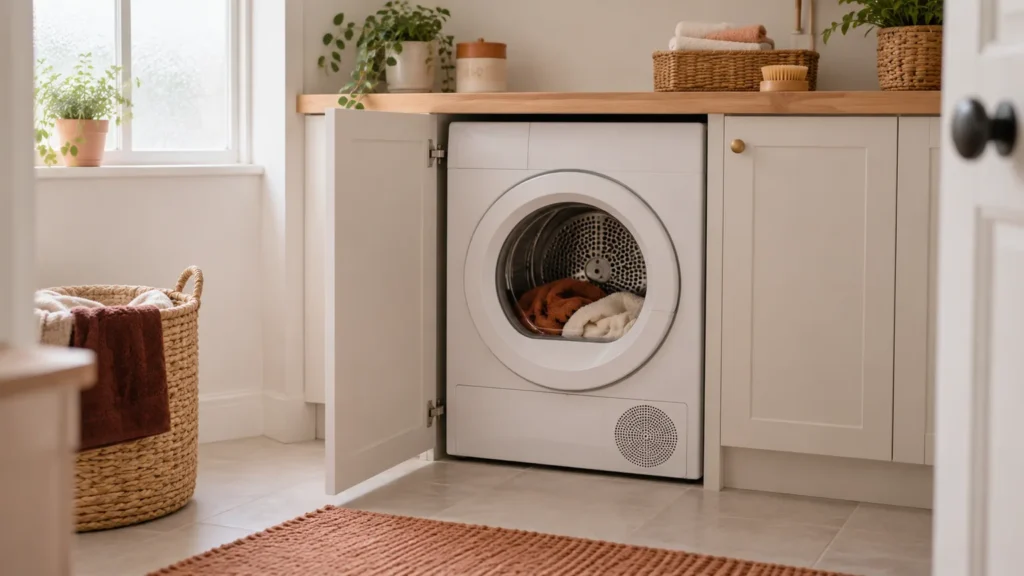
The term “built-in” can refer to different configurations in searches and product listings. To compare appliances effectively, distinguish between integration behind a cabinet door and installation beneath a worktop.
- An integrated tumble dryer is designed to be installed behind a cabinet door, under the conditions specified by its manufacturer.
- An appliance approved for under-counter installation can be placed beneath a worktop if the conditions set out in its manual are met. This does not mean that a kitchen cabinet door can be fitted in front of it.
- A freestanding tumble dryer should not be considered suitable for an enclosed recess solely on the basis of its dimensions.
These terms are therefore not interchangeable. A photograph shows what the appliance looks like, but does not provide enough information about permitted installations, required clearances or cabinet ventilation.
The technology does not settle this question either. Looking for a heat pump tumble dryer may suit your drying preferences, but this designation does not guarantee suitability for any built-in installation. The model’s manual remains the definitive reference.
When should you install a tumble dryer beneath a worktop?
Under-counter installation can be useful when you want to keep a work surface above the appliance or group laundry appliances within a defined space. It can also help create a more visually organised room, where the configuration is approved by the manufacturer.
This option is particularly suitable if the location allows you to maintain easy access to the door and the components that require maintenance. Also check that there is room for the connections and that airflow requirements are still met. An enclosed cabinet requires a specific check and cannot be treated as an open space beneath a worktop.
Browse the selection on this page with these installation constraints in mind first. For the Miele TSD 643 WP, confirm your intended configuration in the manufacturer documentation, then examine the drying features relevant to your household. This approach will help you choose a model that truly suits your home.
How do you choose your built-in tumble dryer?
To choose the best tumble dryer for built-in installation, start by checking that the manufacturer permits your intended installation. Capacity and programmes come next. An appliance that appears to fit inside your cabinet is not necessarily suitable for that location. For the Miele TSD 643 WP, under-counter compatibility still needs to be confirmed in the manual before any decision.
Check which installations the manufacturer permits
The term “built-in” is not enough to define the installation options. A tumble dryer designed to be integrated behind a cabinet door, an appliance approved for under-counter installation and a freestanding tumble dryer have different requirements. Never assume they are compatible based on their appearance.
Consult the manual for the exact model reference. Look for permitted configurations, restrictions and any required accessories. If you want to add a kitchen cabinet door, this option must be explicitly supported.
- Find the installation section.
- Check the specific requirements for an alcove or cabinet.
- Ask the manufacturer for written confirmation if your configuration remains unclear.
Removing the top must also be permitted. Do not plan to dismantle any part to compensate for insufficient height without explicit instructions.
Measure all the space needed for installation
Measure the available height, width and depth at several points within the alcove. Then compare these measurements with the tumble dryer's dimensions and the clearances required in its manual. The depth including connections matters just as much as the depth of the appliance itself.
Also check the access route to the intended location. Installation beneath a worktop must allow you to open the door, load the drum and remove components that need maintenance.
- Allow for the space taken up by hoses and the plug.
- Identify obstacles in front of the door and around the cabinet.
- Make sure the appliance can still be pulled out for servicing.
No universal dimensions can replace the requirements for your chosen model. An alcove that suits another appliance therefore offers no guarantee.
Plan for ventilation and connections
Air circulation must meet the manufacturer's requirements. An enclosed cabinet does not become suitable simply because its door can be left ajar. Check the required openings and any restrictions on the installation environment.
For the electricity supply, make sure the location complies with the manual and that the connection remains accessible as specified. Also clarify how condensate is handled before planning a hose or drainage connection.
If the model uses a tank, check how it can be removed in your intended configuration. If a direct drainage connection is available, check its installation requirements. Finally, locate access points for filters and maintenance areas to prevent a cabinet panel from blocking them.
Choose the performance features your household needs
Once compatibility is established, compare capacity with your usual laundry volume. A larger drum is only worthwhile if your laundry loads justify it. Also examine the programmes suited to the fabrics you actually dry.
To choose between a heat pump tumble dryer and other technologies, consult the technical documentation and energy label for the exact model. Compare the stated energy consumption, programme duration and noise level under comparable conditions.
| Criterion | What to look for | Common mistake |
|---|---|---|
| Installation | An explicitly permitted configuration | Relying on a photograph |
| Space requirements | Measurements that include connections and clearances | Measuring only the empty recess |
| Maintenance | Components that remain accessible inside the cabinet | Blocking access to a filter or water tank |
| Capacity | A capacity suited to your usual laundry loads | Automatically choosing the largest drum |
| Programmes | Cycles suited to your household’s fabrics | Prioritising quantity over usefulness |
Assess the range based on the features you need
Entry-level, mid-range and high-end labels do not establish installation compatibility or suitability for your household. Compare the documented features and disregard those you will not use.
Also factor in the required accessories, any cabinet modifications, installation and maintenance. Without verifiable market research, a numerical range would be of little use. The right choice depends on the full set of needs to be met, rather than commercial positioning alone.
Mistakes to avoid
- Confusing under-counter installation with integration behind a cabinet door.
- Ordering before checking the manual for the exact model.
- Overlooking connections, door opening clearance or maintenance access.
- Enclosing the appliance without checking ventilation requirements.
- Assuming the Miele TSD 643 WP fits your recess. Its model reference is identified, but its dimensions, permitted installation options and connection requirements still need to be checked.
Key takeaways
Only consider an appliance whose compatibility is confirmed for your installation. Then check its overall dimensions, ventilation and maintenance requirements before comparing relevant performance. For the Miele TSD 643 WP, the manufacturer's manual should resolve these uncertainties before you order.
What should you check before installing your tumble dryer?
What is the difference between a built-in tumble dryer and an integrated tumble dryer?
An integrated tumble dryer is designed to take a furniture door, while a dryer described as “built-in” requires you to check the installation options. The term does not guarantee that the appliance can be concealed behind a kitchen cabinet door. A freestanding tumble dryer does not become an integrated model simply because its dimensions fit the recess. The installation options approved by the manufacturer should guide your choice.
Can a tumble dryer be installed under a worktop?
Yes, if the manufacturer permits this installation and the space meets all the requirements in the manual. The available height alone does not confirm compatibility. Also check the depth including connections, the required clearances, airflow and room for the door to open. Filters and components requiring maintenance must remain accessible. A photograph of the appliance under a worktop is no substitute for these checks.
Can a tumble dryer be placed in an enclosed cabinet?
An enclosed cabinet is suitable only if the manufacturer explicitly permits this configuration and its ventilation requirements are met. Do not assume that opening the cabinet door during drying is enough. Check the airflow requirements, clearances and access to components requiring maintenance. Without confirmation of compatibility, it is better to rethink the layout than to order an appliance based solely on its dimensions.
What dimensions are needed for a tumble dryer recess?
The recess dimensions must be determined from the manual for your chosen model, as no universal measurements guarantee a compatible installation. Measure the available height, width and depth. Compare these with the appliance’s overall dimensions, allowing for connections and the specified clearances. Also allow room for the door to open and enough space to access the filters or remove the appliance for maintenance.
Can you remove the top of a tumble dryer to fit it under a worktop?
You should remove the top only if the manufacturer explicitly allows this for the model concerned. A panel that appears removable does not mean that removing it is permitted for installation under a worktop. Consult the manual for the applicable conditions and any accessories required. If this option is not confirmed, choose an appliance that fits the available height or adjust the layout.
Can a heat pump tumble dryer be installed under a worktop?
A heat pump tumble dryer can be installed under a worktop only if its manual permits this configuration. The drying technology does not guarantee compatibility with a recess or cabinet. Check the clearances, airflow and installation conditions for your chosen model. To choose between compatible appliances, then consider electricity consumption and useful programmes, especially if you are looking for a tumble dryer with a quick programme.
Does a built-in tumble dryer need a water drain?
A water drain is not always necessary: it depends on how the model handles condensate. Check the manual to see whether the appliance uses a tank that needs emptying, allows a direct drain connection or requires a particular configuration. When installed in a recess, the tank must remain accessible if it is used. If you plan to connect a drain hose, also check the requirements for routing and connecting it.
Is the Miele TSD 643 WP suitable for installation under a worktop?
The Miele TSD 643 WP’s suitability for installation under a worktop still needs to be confirmed in the manufacturer’s manual. The model reference alone does not establish whether it can be installed under a worktop or integrated behind a cabinet door. Before choosing it, check the permitted configurations, full dimensions, clearances and any accessories required. Make your choice conditional on this confirmation, then compare these requirements with the measurements of your installation space.